
Blog
How to Stop Catastrophic Thinking

Author:
Medical Writer
Saya Des Marais

Medical Reviewer:
Dr. Russell A. Barkley, Ph.D
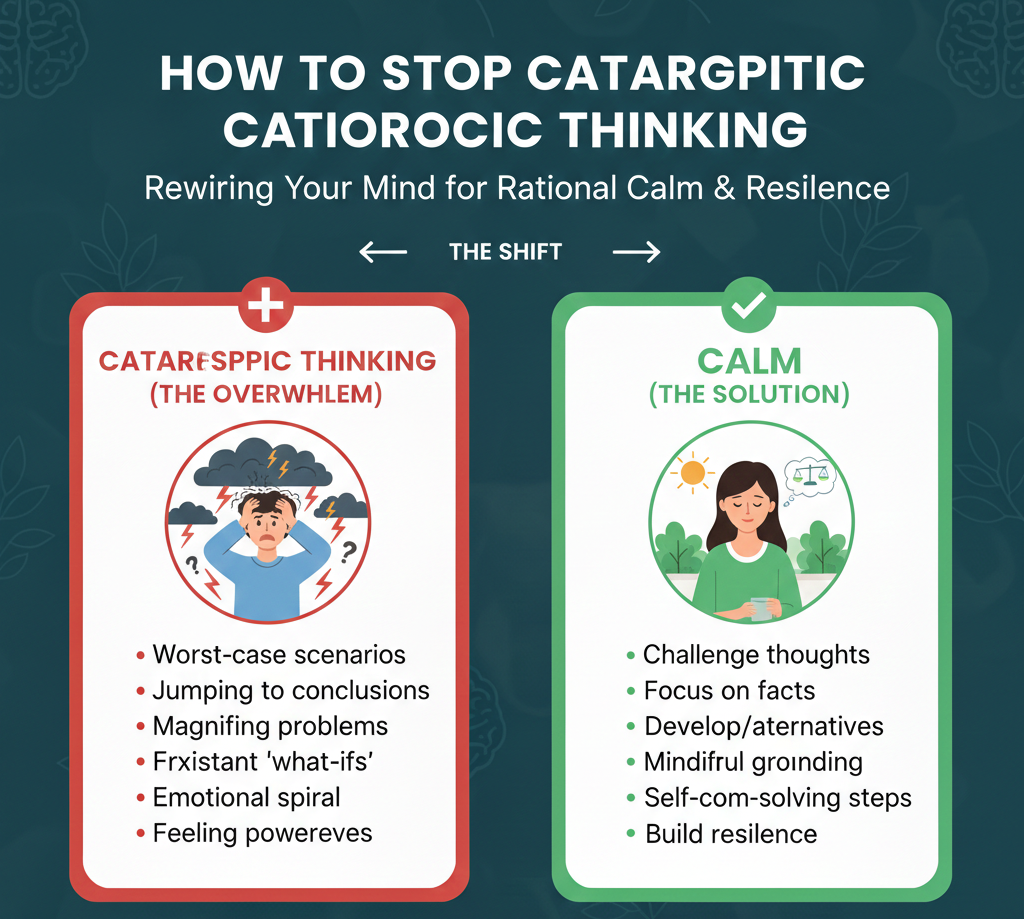
Have you ever made a small mistake and immediately thought, “This is going to ruin everything”? Or felt a minor symptom and convinced yourself it’s something life-threatening? If so, you’ve experienced catastrophic thinking.
Catastrophic thinking is a common mental pattern where the mind automatically jumps to the worst possible outcome — even when the likelihood is low. While occasional worry is normal, persistent catastrophic thinking can fuel anxiety, stress, insomnia, and emotional exhaustion.
The good news? It is a learned mental habit — and habits can be changed. In this guide, we’ll explore what catastrophic thinking is, why it happens, and practical steps you can take to stop it.
What Is Catastrophic Thinking?
Catastrophic thinking is a cognitive distortion — a biased way the brain interprets events. Instead of assessing situations realistically, the mind exaggerates potential dangers and assumes disaster is imminent.
Examples include:
-
“If I mess up this presentation, I’ll lose my job.”
-
“They haven’t texted back — something terrible must have happened.”
-
“This headache must be something serious.”
-
“If this relationship ends, I’ll never be happy again.”
It’s important to understand that catastrophic thinking feels real. Your body responds as if the imagined threat is happening right now. This triggers the fight-or-flight response — increasing heart rate, muscle tension, and stress hormones.
Over time, this pattern strengthens anxiety.
Why Does Catastrophic Thinking Happen?
Catastrophic thinking often develops as a protective mechanism. Your brain is designed to scan for danger to keep you safe. However, in anxiety-prone individuals, this system becomes overly sensitive.
Common triggers include:
-
Chronic stress
-
Past trauma
-
Health anxiety
-
Perfectionism
-
High-pressure environments
-
Lack of sleep
When you’re already stressed or exhausted, your brain is more likely to interpret uncertainty as threat.
Step 1: Recognize the Pattern
You can’t change what you don’t notice.
The first step in stopping catastrophic thinking is identifying when it happens. Pay attention to sudden emotional spikes. Ask yourself:
-
What just triggered this thought?
-
Am I assuming the worst?
-
Do I have solid evidence for this conclusion?
Simply labeling the thought — “This is catastrophic thinking” — creates distance between you and the fear.
Awareness weakens automatic patterns.
Step 2: Separate Thoughts from Facts
One of the most powerful techniques in cognitive behavioral therapy (CBT) is distinguishing thoughts from facts.
For example:
Thought: “I’m going to fail this exam.”
Fact: “I haven’t taken the exam yet. I studied for three weeks.”
Thoughts are mental events — not predictions of reality.
Try writing down your catastrophic thought and then listing actual evidence for and against it. Often, you’ll discover that your fear is based on possibility, not probability.
Step 3: Ask the “Most Likely Outcome” Question
Instead of asking, “What if the worst happens?” ask:
“What is the most realistic outcome?”
Our anxious brain focuses on extremes. But reality usually falls somewhere in the middle.
For example:
Worst case: “I’ll completely embarrass myself during the meeting.”
Most likely: “I might feel nervous, but I’ll get through it like I usually do.”
Shifting focus to probability reduces emotional intensity.
Step 4: Use the 3-Scenario Method
When stuck in catastrophic thinking, outline three scenarios:
-
Worst-case scenario
-
Best-case scenario
-
Most likely scenario
This balanced approach prevents your mind from fixating on extremes.
You may find that your “worst-case” scenario is highly unlikely — and even if it did happen, it would likely be manageable.
Step 5: Practice Grounding Techniques
Catastrophic thinking activates your nervous system. To calm it, focus on grounding techniques.
Try the 5-4-3-2-1 method:
-
5 things you can see
-
4 things you can feel
-
3 things you can hear
-
2 things you can smell
-
1 thing you can taste
This shifts attention from imagined danger to present reality.
Deep breathing exercises can also interrupt the stress response. Slow, controlled breathing signals safety to the brain.
Step 6: Challenge “All-or-Nothing” Thinking
Catastrophic thinking often includes extremes:
-
“Always”
-
“Never”
-
“Ruined”
-
“Disaster”
-
“Total failure”
Replace extreme language with realistic alternatives:
Instead of: “This is a disaster.”
Try: “This is uncomfortable, but I can handle it.”
Language shapes perception. Softer language reduces emotional intensity.
Step 7: Build Tolerance for Uncertainty
At its core, catastrophic thinking is discomfort with uncertainty.
Life includes unknowns. The goal isn’t eliminating uncertainty — it’s learning to tolerate it.
Practice saying:
-
“I don’t know what will happen, and that’s okay.”
-
“I can handle challenges if they arise.”
The more you face uncertainty without trying to control it, the less power it has.
Step 8: Set a “Worry Window”
If your mind constantly spirals, schedule 15 minutes daily as “worry time.”
During this window:
-
Write down all your fears
-
Think through them deliberately
-
Problem-solve where possible
Outside this window, remind yourself:
“I’ll think about this during my worry time.”
This technique limits rumination and prevents all-day catastrophizing.
Step 9: Focus on What You Can Control
Catastrophic thinking often centers on events beyond your control.
Shift attention to actionable steps.
For example:
Instead of worrying about losing your job, ask:
-
What can I do to improve performance?
-
Can I update my resume?
-
Can I build new skills?
Taking small, practical action restores a sense of control and reduces anxiety.
Step 10: Reduce Physical Stress
Mental patterns are stronger when your body is stressed.
Improve resilience by:
-
Getting consistent sleep
-
Reducing caffeine
-
Exercising regularly
-
Eating balanced meals
-
Limiting late-night screen exposure
When your nervous system is regulated, catastrophic thinking becomes easier to manage.
When to Seek Professional Help
Occasional catastrophic thoughts are normal. However, consider professional support if:
-
Catastrophic thinking interferes with work or relationships
-
You experience frequent panic attacks
-
Sleep is regularly disrupted by worry
-
You avoid activities due to fear
-
Anxiety feels uncontrollable
Cognitive Behavioral Therapy (CBT) is especially effective for treating catastrophic thinking. A mental health professional can guide structured exercises tailored to your situation.
A Realistic Perspective on Setbacks
Life includes mistakes, uncertainty, and challenges. But catastrophic thinking exaggerates consequences and underestimates resilience.
Ask yourself:
-
Have I faced difficult situations before?
-
Did I survive them?
-
What strengths helped me cope?
You likely have more resilience than your anxious mind allows you to see.
Building Long-Term Mental Resilience
Stopping catastrophic thinking isn’t about eliminating negative thoughts entirely. It’s about:
-
Noticing them
-
Challenging them
-
Replacing them with balanced alternatives
-
Responding calmly instead of reacting emotionally
Over time, your brain forms new neural pathways. What once felt automatic becomes manageable.
Like any skill, it improves with practice.
Final Thoughts
Catastrophic thinking can feel overwhelming — but it is not a life sentence. It is a mental habit shaped by stress, experience, and fear.
By practicing awareness, challenging unrealistic thoughts, building tolerance for uncertainty, and calming your nervous system, you can retrain your mind to respond more realistically.
You don’t have to believe every thought you think.
The next time your mind jumps to the worst-case scenario, pause. Breathe. Question it.
Often, reality is far less catastrophic than your anxiety predicts.
FAQs
Is guilt a symptom of depression?
Yes, excessive or guilt is listed as a core symptom of Major Depressive Disorder in the DSM-5.
Can guilt cause depression?
While guilt alone doesn’t cause depression, chronic guilt can contribute to its development and worsen existing symptoms.
How do I stop feeling guilty when depressed?
Working with a therapist, practicing self-compassion, and potentially using medication can help manage guilt associated with depression.

Contact us
Have questions? Reach out and we’ll get back to you shortly.
Content
Guilt and Depression at a Glance
How Guilt and Depression Interact
Coping When You’re
Depressed and Feeling Guilty
Evidence-Based Treatments
When to Seek Help
How Loved Ones Can Help
FAQs