
Blog
How Journaling Reduces Overthinking

Author:
Medical Writer
Saya Des Marais

Medical Reviewer:
Dr. Russell A. Barkley, Ph.D
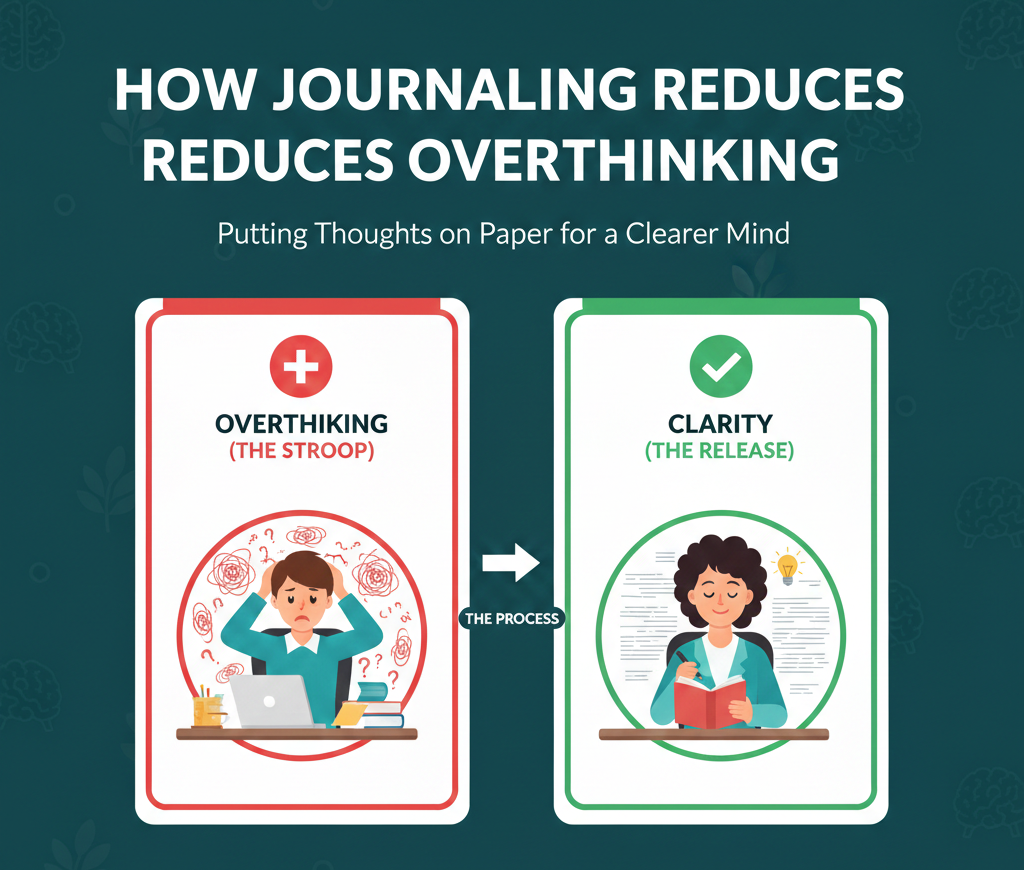
Overthinking can feel like a never-ending mental loop. You replay conversations, anticipate worst-case scenarios, and question every decision. Over time, this habit drains your energy, increases stress, and may worsen anxiety symptoms. While medication and therapy play an important role in anxiety management, simple daily habits can also make a powerful difference. One of the most effective and accessible tools is journaling.
Journaling is more than just writing down your thoughts. It is a structured way to process emotions, organize mental clutter, and gain clarity. In this article, we’ll explore how journaling reduces overthinking, the science behind it, and practical techniques you can start using today.
Understanding Overthinking
Overthinking often stems from anxiety. It involves repetitive thinking patterns such as:
-
Constantly analyzing past events
-
Worrying excessively about the future
-
Imagining negative outcomes
-
Second-guessing decisions
-
Seeking perfection in every situation
When the brain perceives uncertainty or threat, it tries to solve the “problem” by thinking harder. Unfortunately, this rarely leads to solutions. Instead, it creates mental exhaustion and emotional distress.
This is where journaling becomes powerful—it interrupts the cycle.
The Science Behind Journaling and Mental Health
Research in psychology suggests that expressive writing can significantly improve emotional well-being. When you write your thoughts down, you activate the rational part of your brain (the prefrontal cortex), which helps regulate emotional responses from the amygdala—the brain’s fear center.
In simple terms, writing helps you:
-
Slow down racing thoughts
-
Process emotions logically
-
Create structure out of mental chaos
-
Reduce emotional intensity
By transferring thoughts from your mind onto paper, you create psychological distance from them. This makes worries feel more manageable and less overwhelming.
How Journaling Reduces Overthinking
1. Clears Mental Clutter
Your brain is not designed to store every thought. When you try to keep everything inside your head, it becomes crowded. Journaling acts like a mental decluttering system.
Once thoughts are written down, your brain recognizes that they’ve been “saved,” reducing the urge to replay them repeatedly.
2. Breaks the Rumination Cycle
Rumination involves repeatedly thinking about the same problem without reaching a solution. Writing forces you to articulate the issue clearly. Often, you realize:
-
The fear is exaggerated
-
The situation isn’t as bad as imagined
-
There are realistic solutions available
This structured reflection reduces emotional intensity.
3. Provides Emotional Release
Holding emotions inside increases anxiety. Journaling offers a safe, judgment-free space to express anger, sadness, fear, or frustration.
When emotions are expressed rather than suppressed, stress levels decrease significantly.
4. Encourages Rational Thinking
Overthinking tends to be emotionally driven. Writing slows down the process and introduces logic.
For example, instead of thinking:
“I’m going to fail this presentation.”
You write:
“What evidence do I have that I’ll fail? What preparation can I do to improve confidence?”
This shift transforms fear into action.
5. Improves Self-Awareness
Journaling helps you identify patterns:
-
What triggers your anxiety?
-
When does overthinking increase?
-
Which situations create stress?
Recognizing patterns allows you to manage them more effectively.
Types of Journaling for Overthinking
Different techniques work for different people. Here are some of the most effective methods:
1. Brain Dump Journaling
Write everything on your mind without filtering or structuring. Don’t worry about grammar or organization. The goal is to empty your thoughts onto paper.
This technique works best before bedtime to reduce nighttime overthinking.
2. Structured Reflection Journaling
Use prompts like:
-
What am I worried about right now?
-
Is this within my control?
-
What is the worst realistic outcome?
-
What action can I take?
This approach is particularly helpful for problem-solving anxiety.
3. Gratitude Journaling
Overthinking often focuses on negatives. Writing three things you’re grateful for daily shifts your brain toward positive thinking patterns.
Gratitude journaling reduces stress hormones and improves overall mood.
4. Cognitive Reframing Journaling
This method challenges negative thoughts:
-
Write the anxious thought.
-
Identify cognitive distortions (catastrophizing, mind-reading, etc.).
-
Replace it with a balanced statement.
For example:
Anxious thought:
“My boss didn’t reply to my email. I must be in trouble.”
Balanced thought:
“They may be busy. I’ll follow up tomorrow.”
This technique mirrors principles used in cognitive behavioral therapy.
5. Future-Self Journaling
Write from the perspective of your future self who has successfully handled current worries. This builds confidence and reduces fear-based thinking.
How to Start a Journaling Habit
Starting is simple. You don’t need special tools—just consistency.
Step 1: Choose Your Medium
-
Notebook
-
Digital journal
-
Notes app
Step 2: Set a Time
Morning for clarity.
Evening for reflection.
Even 5–10 minutes daily is enough.
Step 3: Remove Pressure
There’s no “right” way to journal. The goal is honesty, not perfection.
Step 4: Stay Consistent
Consistency matters more than length. Small daily sessions are more effective than occasional long entries.
Combining Journaling with Anxiety Treatment
While journaling is powerful, it works best alongside professional care if anxiety is severe.
Many individuals combine journaling with:
-
Therapy
-
Lifestyle adjustments
-
Mindfulness practices
-
Prescribed medications (under medical supervision)
If anxiety significantly interferes with daily life, professional guidance is essential. Journaling can enhance therapy by helping you track symptoms and emotional patterns.
Common Mistakes to Avoid
-
Turning journaling into another perfection task
-
Only focusing on negative events
-
Using it to reinforce worries without reframing
-
Being inconsistent
Remember: Journaling should reduce stress, not add to it.
Long-Term Benefits of Journaling
When practiced regularly, journaling can:
-
Improve emotional regulation
-
Increase resilience
-
Enhance problem-solving skills
-
Reduce stress hormones
-
Improve sleep quality
-
Boost overall mental clarity
Over time, you may notice fewer racing thoughts and greater emotional stability.
Real-Life Example
Imagine someone who constantly overthinks social interactions. After every conversation, they replay what they said, worrying about how others perceived them.
By journaling, they begin to notice a pattern:
-
Fear of judgment
-
Desire for perfection
-
Catastrophic assumptions
Through cognitive reframing in their journal, they gradually replace harsh self-criticism with realistic thinking. Over weeks, the intensity of overthinking decreases.
This demonstrates how powerful structured reflection can be.
Why Journaling Works When Overthinking Doesn’t
Overthinking keeps thoughts trapped inside your mind. Journaling externalizes them.
Overthinking is circular.
Journaling is linear.
Overthinking increases anxiety.
Journaling reduces it.
By creating space between you and your thoughts, writing restores a sense of control.
Final Thoughts
Overthinking can feel overwhelming, but it is manageable with the right tools. Journaling is one of the simplest, most affordable, and evidence-based techniques to reduce mental clutter and anxiety.
You don’t need to write perfectly. You don’t need hours each day. You just need a willingness to put thoughts onto paper.
Start small. Stay consistent. Over time, you’ll likely notice that your mind feels lighter, clearer, and more balanced.
If anxiety persists or worsens, seek professional support. Journaling is a powerful complement—but not a replacement—for medical or psychological treatment when needed.
FAQs
Is guilt a symptom of depression?
Yes, excessive or guilt is listed as a core symptom of Major Depressive Disorder in the DSM-5.
Can guilt cause depression?
While guilt alone doesn’t cause depression, chronic guilt can contribute to its development and worsen existing symptoms.
How do I stop feeling guilty when depressed?
Working with a therapist, practicing self-compassion, and potentially using medication can help manage guilt associated with depression.

Contact us
Have questions? Reach out and we’ll get back to you shortly.
Content
Guilt and Depression at a Glance
How Guilt and Depression Interact
Coping When You’re
Depressed and Feeling Guilty
Evidence-Based Treatments
When to Seek Help
How Loved Ones Can Help
FAQs