
Blog
Cognitive Behavioral Therapy Techniques for Anxiety

Author:
Medical Writer
Saya Des Marais

Medical Reviewer:
Dr. Russell A. Barkley, Ph.D
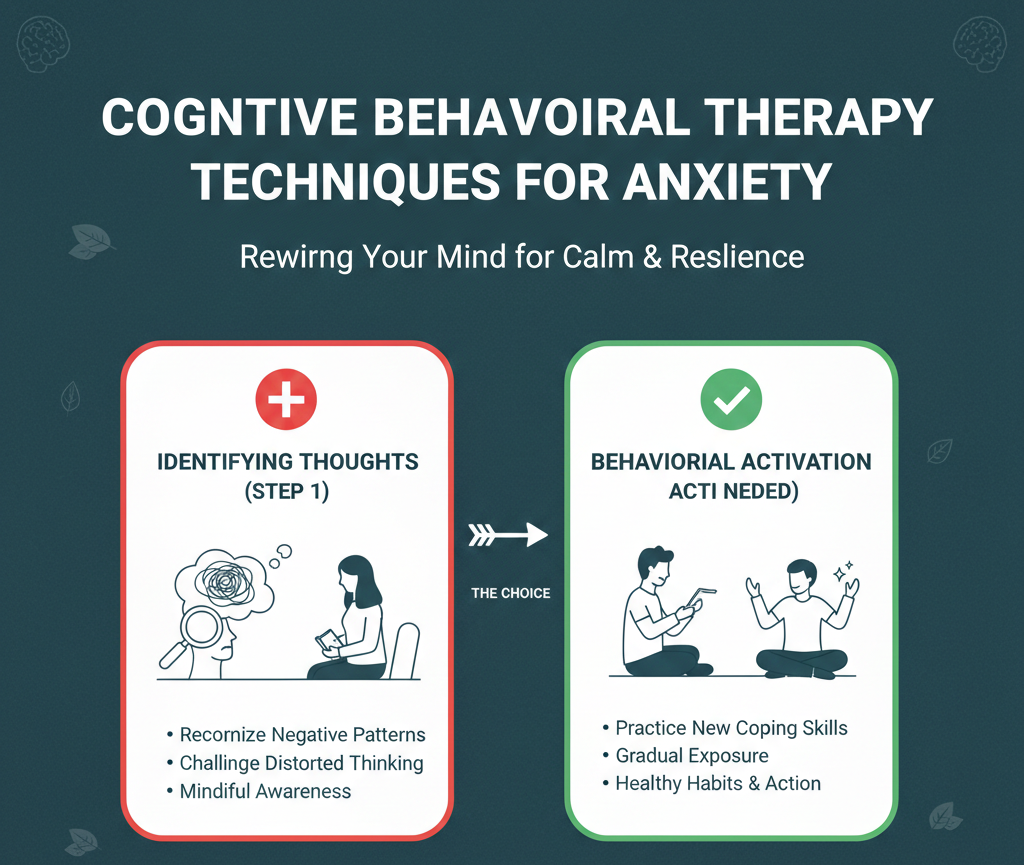
Anxiety disorders affect millions of individuals worldwide, often interfering with work, relationships, and overall quality of life. While medication can be helpful in certain cases, psychotherapy remains one of the most effective long-term treatments. Among all therapeutic approaches, Cognitive Behavioral Therapy (CBT) stands out as one of the most evidence-based and widely recommended methods for anxiety management.
But what exactly is CBT, and how does it work? More importantly, what practical techniques can help reduce anxiety symptoms?
In this article, we explore the core principles of CBT and the most effective techniques used to manage anxiety.
What Is Cognitive Behavioral Therapy (CBT)?
Cognitive Behavioral Therapy is a structured, goal-oriented form of psychotherapy that focuses on the connection between thoughts, emotions, and behaviors.
The fundamental idea behind CBT is simple:
Your thoughts influence your feelings, and your feelings influence your behaviors.
When anxious thoughts become distorted or exaggerated, they trigger emotional distress and physical symptoms. CBT helps individuals identify, challenge, and replace unhelpful thought patterns while developing healthier behavioral responses.
Why CBT Is Effective for Anxiety
CBT is considered a first-line treatment for many anxiety disorders, including:
-
Generalized Anxiety Disorder (GAD)
-
Panic Disorder
-
Social Anxiety Disorder
-
Phobias
-
Post-Traumatic Stress Disorder (PTSD)
Research consistently shows that CBT:
-
Reduces symptom severity
-
Decreases relapse rates
-
Improves coping skills
-
Provides long-term benefits
Unlike medication alone, CBT teaches skills that individuals can use throughout life.
Common CBT Techniques for Anxiety
Below are some of the most effective CBT techniques used in anxiety treatment.
1. Identifying Negative Thought Patterns
Anxiety often involves automatic negative thoughts, such as:
-
“Something bad is going to happen.”
-
“I can’t handle this.”
-
“I’m going to embarrass myself.”
The first step in CBT is awareness. Individuals learn to recognize these thoughts when they arise.
A helpful exercise includes keeping a thought journal:
-
What happened?
-
What did I think?
-
How did I feel?
-
How intense was the emotion (1–10)?
This process builds awareness of how thinking patterns influence anxiety.
2. Cognitive Restructuring (Thought Challenging)
Once negative thoughts are identified, CBT teaches how to challenge and replace them.
Ask yourself:
-
What evidence supports this thought?
-
What evidence contradicts it?
-
Am I catastrophizing?
-
What would I tell a friend in this situation?
For example:
Anxious Thought: “If I make a mistake during the presentation, everyone will think I’m incompetent.”
Balanced Thought: “Most people make small mistakes. It doesn’t define my abilities.”
Over time, practicing cognitive restructuring reduces exaggerated fear responses.
3. Behavioral Experiments
Behavioral experiments test anxious predictions in real life.
For instance, someone with social anxiety may believe, “If I speak up in a meeting, people will judge me.”
Instead of avoiding the situation, CBT encourages small, planned experiments:
-
Speak briefly during a meeting
-
Observe others’ reactions
-
Evaluate the outcome
Often, individuals discover their feared outcomes are less severe than imagined.
4. Exposure Therapy
Avoidance strengthens anxiety. The more we avoid feared situations, the more powerful the fear becomes.
Exposure therapy gradually introduces feared situations in a safe, controlled manner.
For example:
If someone fears driving, exposure may involve:
-
Sitting in a parked car
-
Turning on the engine
-
Driving around the block
-
Gradually increasing distance
Exposure reduces anxiety over time by teaching the brain that the feared situation is not dangerous.
5. Relaxation Techniques
CBT often incorporates physical calming strategies to reduce symptoms.
Deep Breathing
Slow, diaphragmatic breathing helps regulate the nervous system.
Try this method:
-
Inhale for 4 seconds
-
Hold for 4 seconds
-
Exhale for 6 seconds
-
Repeat for 2–5 minutes
This technique helps reduce rapid heart rate and muscle tension.
Progressive Muscle Relaxation (PMR)
This involves tensing and relaxing muscle groups systematically to release physical tension.
Steps include:
-
Tighten a muscle group (e.g., shoulders) for 5 seconds
-
Release for 10 seconds
-
Move to the next muscle group
PMR reduces physical symptoms that often accompany anxiety.
6. Mindfulness-Based CBT
Mindfulness teaches individuals to observe thoughts without judgment.
Instead of fighting anxious thoughts, you acknowledge them:
“I’m noticing I’m feeling anxious.”
This approach reduces emotional reactivity and helps create distance from distressing thoughts.
Mindfulness practices may include:
-
Guided meditation
-
Body scans
-
Grounding exercises
7. Activity Scheduling
Anxiety can lead to withdrawal and inactivity, which may worsen symptoms.
CBT encourages structured activity scheduling:
-
Plan enjoyable activities
-
Break tasks into manageable steps
-
Set realistic goals
Engaging in positive activities improves mood and reduces rumination.
8. Problem-Solving Skills
Sometimes anxiety stems from real-life stressors. CBT helps individuals develop practical problem-solving strategies:
-
Define the problem clearly
-
Brainstorm possible solutions
-
Evaluate pros and cons
-
Choose a solution
-
Review the outcome
This structured approach reduces feelings of helplessness.
How Long Does CBT Take to Work?
CBT is typically short-term, often lasting 8–20 sessions depending on severity.
Many individuals notice improvements within a few weeks, especially when practicing techniques consistently outside therapy sessions.
Commitment to homework exercises plays a crucial role in success.
CBT vs. Medication for Anxiety
Both CBT and medication are effective treatments. The choice depends on:
-
Severity of symptoms
-
Personal preference
-
Medical history
-
Response to previous treatments
For mild to moderate anxiety, CBT alone may be sufficient. For more severe cases, a combination of CBT and medication may provide optimal results.
CBT has the advantage of teaching lifelong coping skills, reducing reliance on medication alone.
Who Can Benefit From CBT?
CBT is suitable for:
-
Adults
-
Teenagers
-
Children (with modifications)
-
Individuals with co-occurring depression
-
People experiencing chronic stress
It is adaptable and personalized based on individual needs.
Can You Practice CBT on Your Own?
While working with a licensed therapist is ideal, some CBT techniques can be practiced independently using:
-
Self-help books
-
CBT workbooks
-
Mental health apps
-
Guided online programs
However, professional guidance ensures correct application and deeper exploration of thought patterns.
When to Seek Professional Help
Consider consulting a healthcare provider if:
-
Anxiety interferes with daily functioning
-
Panic attacks are frequent
-
Avoidance behaviors are increasing
-
Symptoms persist for several months
-
Anxiety coexists with depression
Early intervention improves long-term outcomes.
The Long-Term Benefits of CBT
One of the strongest advantages of CBT is its lasting impact. By changing thought patterns and behaviors, individuals retrain their brain’s response to stress.
Over time, this leads to:
-
Reduced fear responses
-
Improved emotional regulation
-
Increased confidence
-
Better decision-making
-
Greater resilience
CBT empowers individuals to become active participants in their recovery.
Final Thoughts
Cognitive Behavioral Therapy techniques for anxiety provide practical, research-backed tools to regain control over overwhelming thoughts and emotions. From thought challenging and exposure therapy to relaxation and mindfulness practices, CBT offers structured methods to reduce anxiety at its core.
While anxiety can feel overpowering, it is treatable. With consistent effort, guidance, and skill-building, individuals can learn to manage symptoms effectively and improve their quality of life.
If anxiety is affecting your daily routine, seeking professional support may be the first step toward lasting relief. CBT is not just about reducing symptoms—it’s about building resilience and reclaiming confidence in everyday life.
FAQs
Is guilt a symptom of depression?
Yes, excessive or guilt is listed as a core symptom of Major Depressive Disorder in the DSM-5.
Can guilt cause depression?
While guilt alone doesn’t cause depression, chronic guilt can contribute to its development and worsen existing symptoms.
How do I stop feeling guilty when depressed?
Working with a therapist, practicing self-compassion, and potentially using medication can help manage guilt associated with depression.

Contact us
Have questions? Reach out and we’ll get back to you shortly.
Content
Guilt and Depression at a Glance
How Guilt and Depression Interact
Coping When You’re
Depressed and Feeling Guilty
Evidence-Based Treatments
When to Seek Help
How Loved Ones Can Help
FAQs